
Should jury trials be abolished for lesser offences?
In 1179, when Henry II introduced panels of knights to determine land disputes at the Grand Assize, it is unlikely he would have foreseen that trial by jury would catch on quite so widely. Trial by battle no doubt had its 12th century adherents and trial by ducking stool persisted as an apparently reliable method for determining certain witchcraft offences until 1750. However, we are now forced to consider whether the jury trial remains fit for purpose or was ever quite as fit as we thought it to be. Eligibility for jury service has required surprisingly recent refinement, to include women and remove property ownership qualifications. The UK’s socio-economic landscape is increasingly uncertain and post-truth narratives interfere with our ability to make any objective decisions. The jury system is not coping with the volume of adjudications required of it. In March 2025, the Ministry of Justice announced a record Crown Court trial backlog of 76,957 cases. Abolishing this medieval anachronism for less important offences seems like a quick and righteous fix. Yet does it really address the underlying causes of our current difficulty? And what are the consequences of imposing summary justice?
This essay acknowledges the huge drain on resources that jury trials present but will conclude that further change is undesirable and addresses symptoms rather than the cause of the problem. The ‘affective’ analysis of the courtroom process highlights the centrality of emotion to judicial determination. The jury system is at the heart of community decision making but can’t sustain the community by itself.
The Drain on Resources and Criminal Justice System Backlog
The right to fair trial is a fundamental aspect of the Rule of Law. However, when A.V. Dicey was expounding the Rule of Law, the UK’s population was estimated to be around 27 million. A century and a half later, it stands at just over 69.5 million. The Criminal Justice System is now on its knees from endless budget cuts, compounded by social change and a global pandemic. In 2023, the average cost of a Crown Court sitting day was £3,036. A streamlined service would help accessibility to a fair trial and would free up money, time, and human resources.
Sir Brian Leveson has been a vocal advocate for reform. He argues there is a need to step away from any fanciful imaginary we might have of the justice system and realise that this is simply a numbers game – there are too many cases, taking too long, presided over by too few judges. By removing the right to elect trial by jury in cases where the maximum sentence is less than two years imprisonment, creating a new Crown Court Bench Division (CCBD) and moving serious fraud cases to be heard by judges alone, Sir Brian argues 9,000 sitting days could be saved in the Crown Court each year. Law need not always be a quest for justice, sometimes it is purely transactional. The broad success of reforms within the civil courts, guided by the overriding objective and ADR, offers a template for fast track solutions and restorative justice.
Alternatives to Juries
Putting aside the arguments for efficiency, we must consider public perception of change. Taking power away from the jury and handing it to the judiciary creates a symbolic and practical disconnect from community led determination. Decision-making is concentrated in an unrepresentative group, potentially eroding checks and balances upon reflexive guilty verdicts.
There is no shortage of criticism for the lack of racial, gender and socio-economic diversity on the Bench and indeed, at the Bar. Public confidence in the justice system is fragile, with some regarding it as still a “[White] Man’s Game”. Whilst the argument for reform appears straightforward as an accounting exercise, non-fiscal factors must also be balanced.
It may be argued that judicial selection and training have evolved to be a superior form of justice. Judges can be alert to cognitive bias in all its forms, inoculated to the distraction of hyperbolic advocacy and on top of the lesser offending game. But if efficiency becomes the overriding metric, why permit any human involvement? The computational power of AI is progressing exponentially and will likely come to define the next human epoch. If AI can be trained to read fraud trial documents without confusion (or boredom), detect every vocal inflection and physical gesture in the Courtroom, and ignore the cognitive bias which afflicts all humanity then why should we hesitate to change?
Legal Realism
The partition between law and emotion is a deeply entrenched paradigm. Hobbes noted that the ideal judge is divested “of all fear, anger, hatred, love and compassion”. This clean separation stems from Cartesian ideals of Mind-Body dualism; the rational mind should be detached from the irrational and messy body. Alex Jeffrey states “one of the key achievements of law is its ability to produce stability, to perform a sense of legal spaces as timeless, ordered and rational”. Courtrooms are thought of as spaces of impartiality, candour and objective truth. The phrase ‘Sine ire et studio’ – without anger or passion – has long been used to describe proper practice in the court of law. This reality is enforced by the court itself – “the emotive-cognitive judicial frame systematically silences emotions”. Indeed, Terry Maroney states that “to call a judge emotional is a stinging insult, signifying a failure of discipline, impartiality and reason”. Those who would abolish jury trials for lesser offences see the courtroom through a lens which is dispassionate and sterile.
The 20th century Critical Legal Studies Movement argued that this is all a long con. From the perspective of the layman, law is a distant notion, clouded by “jargon designed to bamboozle and impoverish the average citizen”. They attempted to unpack this jurisprudential scam, attacking “the conception of law as a brooding omnipresence in the sky”. When we distinguish – or seek to distinguish – between serious and lesser crime, we add another layer of obfuscation, decided under the smoke and mirrors of judicial misdirection.
But if efficiency becomes the overriding metric, why permit any human involvement? The computational power of AI is progressing exponentially and will likely come to define the next human epoch.
A climate protestor with Insulate Britain has recently been acquitted of contempt of court for holding a placard to inform jury members of their ancient right to acquit a defendant based on their conscience, regardless of directions from the judge. An appeal to the conscience of the jury seems to have been behind the acquittal of Just Stop Oil protesters for throwing orange dyed powder at Stonehenge, causing £620 of damage. Self-determination according to conscience is the canary in the coal mine of our criminal justice system, which would be snuffed out by the abolition of juries in ‘lesser’ cases. Who holds the sorting hat which determines their importance?
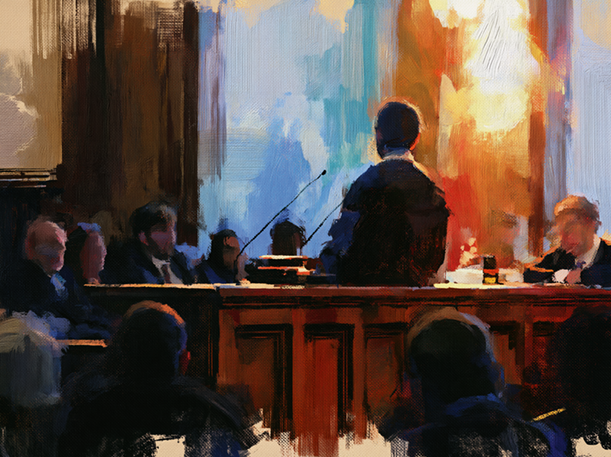
The sensations, compulsions and restraints involved in the exercise of law should be understood as a networked process. Notions of ‘affect’ are not limited to the whims of a judge or jury, nor to their written or spoken language. They are present in the relations between courtroom actors, in the material experience of the environment, and in the ‘affects’ of individual and collective emotion which percolate. It is this essay’s submission that those who would abolish jury trials for lesser offences fail to appreciate this delicately balanced system or why it is that our focus should be upon the messy systemic whole.
Budget cuts in the justice system have been burning the candle down at both ends. The Courts cannot cope with increasing numbers of jury trials, and the police lack the resources to investigate offending. The high-profile shoplifting trials of the 1990s are long gone. The reality is that shoplifting, domestic violence and anti-social behaviour are now rarely charged, let alone triable either way. For the victims of these crimes, for whom the impact may not be lesser at all, justice is a non-starter.
It is vital to think about how we got here. Housing, education, youth engagement and employment are the key controls upon lesser offending. Prisons operating at 97% of capacity are unlikely to offer much by way of rehabilitation. Closure of Court Buildings leave us in seemingly permanent deficit. None of this is a function of jury trial election.
Conclusion
In his lecture “The English Criminal Trial: Credits and Debits”, Lord Bingham references Oliver Cromwell’s instructions to his portrait painter. His instructions were candid and simple; to be in his likeness, including all the “roughness, pimples, warts and everything else you see”. Much like Cromwell’s face, Lord Bingham continues, the English Criminal Justice System has its imperfections. This essay has not sought to conceal these blemishes. However, abolishing jury trials for lesser offences is not the answer. In the courtroom, affective atmospheres do not have a simple hierarchy of cause and effect, nor are they self-contained. They continually shape procedural mechanisms and are also shaped by them. Once communities give up making their own emotional decisions, they cease to be communities. To regard emotion as capable of extraction from the judicial process is shortsighted and fundamentally flawed – we should instead look to the externalities and political lifestyle choices which have resulted in the impasse.
Nicholas Grimshaw
ITSA Essay Competition Winner, 2025