
Report on ‘Inquests & Inquiries: Inquisitorial or Adversarial?’ Conference
THE INNER TEMPLE 16 MAY 2026
In light of the ever-increasing number of inquiries and inquests, it was decided that, as part of the Established Practitioners Programme (EPP), a one-day conference would be held to discuss these forms of hearings. In recent years, both have attracted criticism regarding their length, the areas of their investigation and, not least, the content and style of questioning. The objective of this event was set out as “to enable participants to obtain a better understanding of the purpose and structure of the hearings and the skills required for effective advocacy in them”. It was also considered that advocates would be assisted by hearing from those who had appeared as witnesses at either an inquest or an inquiry.
By Inner Temple
The programme was devised by Masters Korner and Leonard (with the assistance of Master Stein and Master Wilson, as well as the Inn’s staff). It was divided into the following sessions:
‘Inquests & Inquiries: Perspective of Coroner & Chairman’ (Speakers: Master Lucraft and Master Hughes)
‘Preparing and Conducting Inquests and Inquiries: Counsel’s Perspective’ (Speakers: Master Beer and Stephen Simblett KC)
‘Are the Proceedings Inquisitorial or Adversarial?: The Witnesses’/Supporters’ Perspective’ (Speakers: Lord Arbuthnot of Edrom, David Enright, Toby Williamson – session chaired by Master Christina Lambert)
Separate breakout panels to discuss representation and advocacy in inquests and inquiries (Thea Wilson chaired the inquests panel and Master Beer chaired the inquiries panel).
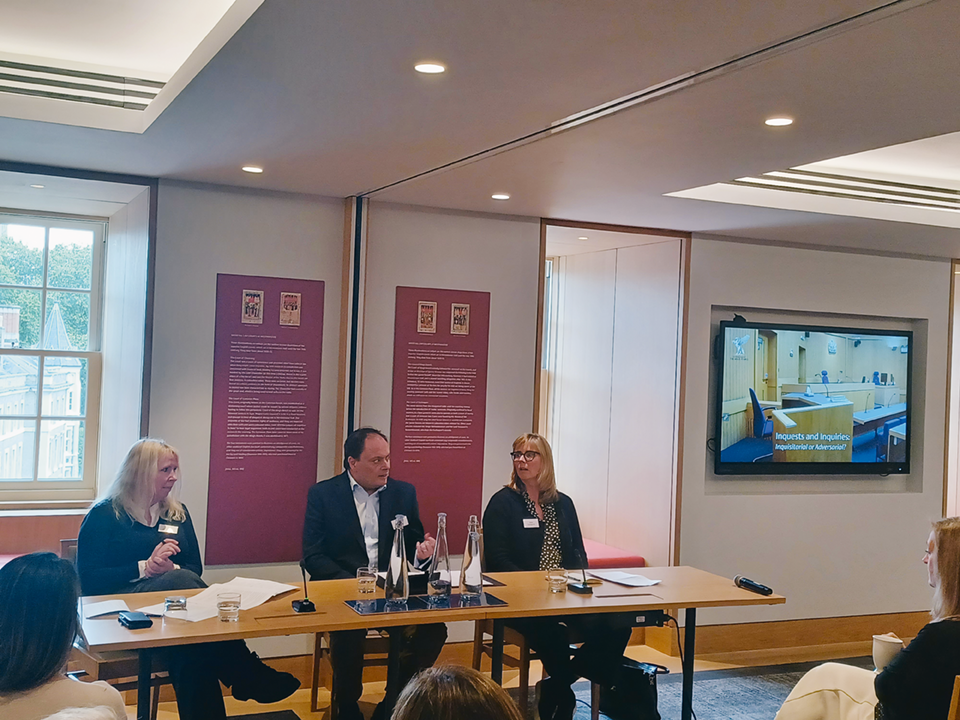
The Conference benefited from the huge experience of the speakers (no doubt a factor in filling the lecture theatre almost to capacity). Master Lucraft (as the former Chief Coroner) presided, inter alia, over the inquests following the London Bridge/Borough Market and Fishmongers’ Hall terrorist attacks. Master Hughes chaired the Salisbury Novichok Inquiry. Whilst there is a Bench book for Coroners’ courts, no such guidance exists in respect of inquiries; as Master Hughes explained, the procedures are left entirely to the Chairman. Moreover, he pointed out that there is a relationship between the Chair and Counsel to the Inquiry. Regarding questioning during inquests, Master Lucraft pointed out that it is the coroner who asks the key questions.
The afternoon panels provided an opportunity not just to hear from experienced practitioners but also promoted interactive discussion with the attendees. Master Beer again underlined the more ad hoc nature of inquiries, pointing out that the form of advocacy could be traditional, restricted (where counsel for core participants ask virtually no questions) or a hybrid of both, ie the vast majority of questioning is done by Counsel to the Inquiry (who would both examine and cross-examine, using questions given by counsel for the core participants), and cross-examination by counsel is time-limited.
The last session in the morning – expertly chaired by Master Lambert (who had been Counsel to the Coroner in the Hillsborough Inquiry) – brought together Toby Williamson (who had been present at the Fishmongers’ Hall attack and gave evidence at the inquest), Lord Arbuthnot (who gave evidence at the Post Office Inquiry) and David Enright (a solicitor who has acted for core participants in inquiries including Grenfell and the Post Office). This was a unique opportunity for practitioners to hear what the experience was like for those who had to appear as witnesses in inquests and inquiries. Each of the speakers gave a real and valuable insight into just how emotional an occurrence it had been, and Lord Arbuthnot highlighted the importance of the assistance he had received through the questions put by Master Beer as Counsel to the Inquiry. The feedback forms from attendees variously described this session as “especially fascinating,” “particularly insightful” and “exceptional”.
The feedback forms, in general, demonstrated that the conference had achieved its objective. To quote but one attendee, “Fantastic event. I didn’t expect to find this [so] engaging and genuinely helpful. The selection of speakers was excellent. I learnt an enormous amount today.” When asked about future events as part of the EPP course, more than one person suggested that it would be useful to hold an advocacy training course/mock trial with a case study based on an inquest scenario.