ORAL HISTORY
We were delighted to continue the third phase of our oral history project this year, welcoming a new group of students and barristers to a training day in May with Sarah Lowry of the British Library. It is intended that they will capture the collective memory of the Inn through conversations with long-serving staff and members.
The trainee oral historians have already conducted several interviews, offering fascinating glimpses into life at the Inn at a particular moment in the legal world. Together, these personal recollections form a rich and increasingly important record of the Inn’s professional and social history, preserving experiences, memories and perspectives that might otherwise be lost.
For this yearbook each interviewer has selected a favourite extract from their interview and explains what makes it particularly memorable or significant to them. These early interviews provide a snapshot of the project recording fascinating lives which we hope will inspire others with insights for their own career journeys.
Featured interviews include:
- ABHISHEK DHOL, student member of the Inn, in conversation with Margaret Clay, former Librarian of the Inn (1991–2020)
- MASTER BIBI BADEJO, interviewed by Maxine Quintyne-Kolaru, a Trade Union representative and barrister (Unregistered). She volunteers regularly for the Inner Temple’s Education and Training department
- MASTER SIMON REGIS, interviewed by Shiven Chudasama, student member of the Inn and Fees Clerk at 7BR
- MASTER LAWRENCE, interviewed by Professor Susan Edwards KC (Hon)
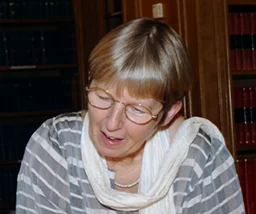
Margaret Clay
interviewed by Abhishek Dhol
Margaret Clay, whom I interviewed, was the Librarian and Keeper of Manuscripts at the Inner Temple from 1991 to 2020.
Speaking with her taught me much about how institutional cultures change. Her advocacy for positive change in her leadership capacity is an object lesson in abandoning preconceived assumptions when thinking about culture changes in institutions.
I understood how an open-minded approach focused on learning about the individual impact of systemic issues, and a determination to do something about them, are key ingredients for successful positive culture change.
This interview also demonstrates the importance of a holistic approach. Clay comments on old-fashioned dressing customs being observed until recently, a possible barrier to certain talented people accessing the Inn and its offerings. The collaboration to change such cultures, combined with work to make the Library more accessible to disabled people, highlights the need for a holistic approach to positive culture change.
The selected extracts highlight the positive character traits that contributed to Margaret Clay making a significant positive difference: humility, kindness and generosity, courage to remain undaunted by difficult problems, and a willingness to tackle them. My only critique is perhaps an excess of humility: a tendency to understate her achievements. This makes her a challenging, but ultimately rewarding, case study for the student of leadership. The picture that emerges is of a person whose approach to life and service for others is worth emulating.
Extracts from interview with Margaret Clay
Interviewer: What were your first impressions of the Inner Temple when you came to work here?
Margaret: When I arrived at the Inn, it felt a very traditional and conservative working environment – such a hierarchy, Lunching in Hall, Benchers were at the top table with everyone else in the main body of the Hall. There was a strict formal dress code. Men had to keep their jackets on, whatever the temperature, and would not be admitted if they were not wearing a tie, and women were not allowed to wear trousers. Over the years that kind of formality disappeared and a much broader range of the membership lunched in Hall.
Interviewer: How has the demographic of the membership changed over your time here?
Margaret: Definitely more women and more Black and Asian students training for the Bar. As for where students are educated, there are probably more state-educated students than there were, which may be due to the Inn’s outreach work with schools.
Interviewer: How did the Library contribute to those outreach efforts?
Margaret: The Deputy Librarian, Tracey Dennis, took the lead. She participated in Education and Training events at the Inn when school and university groups visited, and gave tours of the Library when time allowed. She also led on legal research training activities. Outreach to prospective members was mainly through tours and talks.
Interviewer: How did your work with housebound library users influence your thinking about… adapting services for disabled users [at Inner Temple]?
Margaret: We gave a lot of thought to accessibility generally and access to online materials. […]We bought height-adjustable tables so that users could work in their wheelchairs and be comfortable. We had portable induction loops for those who were hard of hearing. I made a number of visits to the RNIB to see what they would recommend as aids to blind and partially sighted library users… As a result, in the Library we had large screen terminals and video magnifiers. We purchased Jaws screen-reading software and headphones so they could be used with commercial databases. That was all done in the early two thousands, and we upgraded the hardware and software over time. There were barristers with physical disabilities that prevented them from using the Library. We could make a special case for these individual members who needed access to one of the extensive online services such as Westlaw or Lexis. If I put forward a case to the providers, they would usually allow remote access for that particular user.

Master Bibi Badejo
interviewed by Maxine Quintine-Kolaru
I really wanted to interview Bibi Badejo. After receiving the Oral History Project training, I specifically requested the opportunity and had the great pleasure of interviewing Bibi on 19 June 2026 at her chambers, 4 Paper Buildings (4PB).
I first met Bibi through Bridging the Bar, where she delivered a fantastic advocacy workshop as part of The Advocacy Coach, which she founded. Bibi is phenomenal: a governing Bencher, advocacy coach and trainer, podcaster, published author and working mother. I was fascinated to gain insight into what ignited and sustained her passions and achievements, and documenting this as part of the Oral History Project has been a real privilege.
The interview was fascinating and engaging, providing a real spotlight on her brilliance. Selecting particular insights was therefore a challenge, but what would a barrister be if they didn’t like taking on challenges?
Given the highly competitive nature of pupillage, I assumed Bibi’s route must have been smooth. Surprisingly, she told me her “journey to pupillage had been long and rather protracted.” She explained: “I didn’t do as well in my A levels as I had hoped, and so I had to go through clearing, and ended up doing a History and Politics degree, which I absolutely loved.”
After graduating at 20, she completed a three-year law degree at UCL, was called to the Bar, and then waited three years for pupillage. “It took me three years before I got pupillage… you’re just there waiting and doing your best to refine your CV and get all of this experience and try and stand out in some way.” She described this as: “probably the most frustrating and the saddest time of my life because it was my dream to be a barrister, and it felt like it was being taken away from me.”
Characteristically, Bibi never gave up, buoyed by advice from Inn members to “Just persevere.” She did, and ultimately secured pupillage with one interview. When I asked what drove her passion for law, she laughed: “it feels really silly, but I love LA Law… I loved it, and thought: ‘I want to be a lawyer.’”
Bibi also spoke passionately about equality and inclusion, describing her “genuine commitment to equality, diversity and inclusion” and the positive changes she has seen at the Inner Temple. Yet she has experienced sexism and racism in practice. One lucrative ten-day hearing was removed because: “the client wanted a man.”
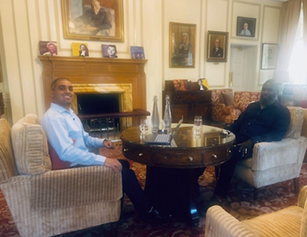
Master Simon Regis
interviewed by Shiven Chudasama
This interview with Master Simon Regis gave me an opportunity to reflect on the changing nature of the Bar, from the realities of pupillage and self-employment to the responsibilities of becoming a Bencher. His reflections challenged some of my own assumptions and encouraged me to consider how experience and perspective shape a barrister’s journey. I have chosen these extracts because they demonstrate not only how the Bar has evolved, but also how Master Regis’ own journey has inspired and informed my understanding of my own.
On looking back at pupillage and the self-employed Bar
“You know, looking back on it now with hindsight and experience, I wouldn’t get – I would definitely, if I was to have a conversation with my younger self, it would be, “You need to get off your principled pedestal about how you think things work, and actually look properly at how things do work and what you need to do to be able to get ahead in the profession in the way in which you wanted to at that particular point in time.”
I have decided to go with this extract for a number of reasons. Firstly, I think it perfectly encapsulates Mr Regis’ position in reflecting upon transitioning from the self-employed to the employed Bar. Secondly, his reflection is not of regret but of nostalgia and sound advice. Thirdly, it allows me to learn from him challenging my own preconceptions of the Bar in terms of networking and marketing. It is important when you’re young, I think, to learn how things work and use that for your benefit rather than to stick rigidly to your principles which can sometimes hinder your chances of progress and growth. I would not want to compromise myself, but I would not want to shut off learning opportunities because of something I do not like or want to do. Throughout the interview, Mr Regis was educating and this distinction he made was valuable. I learnt that you have to be uncomfortable to develop. Master Regis’ reflections encouraged me to approach my own journey with a combination of conviction and pragmatism, whilst being open and adaptable to see how things work.
On being a Master of the Bench at the Inner Temple
“So when it’s on your – the table cards, I recognise that [it] has to go there. I’m not going to say anything. I’m not going to take a pen and scratch it out. But in terms of personal address, or if people are communicating with me from the Inn, as a Master of the Bench, they will always address me as Master Regis, and I will then respond to it, and then normally say to them, “Oh, by the way, the next time you email me or communicate with me, can you just call me Simon?”
The outward view of Benchers is that they are a community of senior Barristers and judges who belong to an Inn at a position of high authority and reverence. I wasn’t quite sure what Benchers did until Master Regis explained during and after the interview. At no point did Mr Regis strike me as a typical Bencher, and maybe that is an indication of the evolving Bar. So this extract is interesting to me, because he was explaining having titles before and after his name and the unique feeling that comes from it, which separates you from people before they may have even put a face to the name. As a Bencher, everyone at the Inn addresses him as Master Regis, and officially he is also known as Master Simon Regis CBE, having been awarded the Order in 2024 following his legislative work on Brexit and the Coronavirus Pandemic.
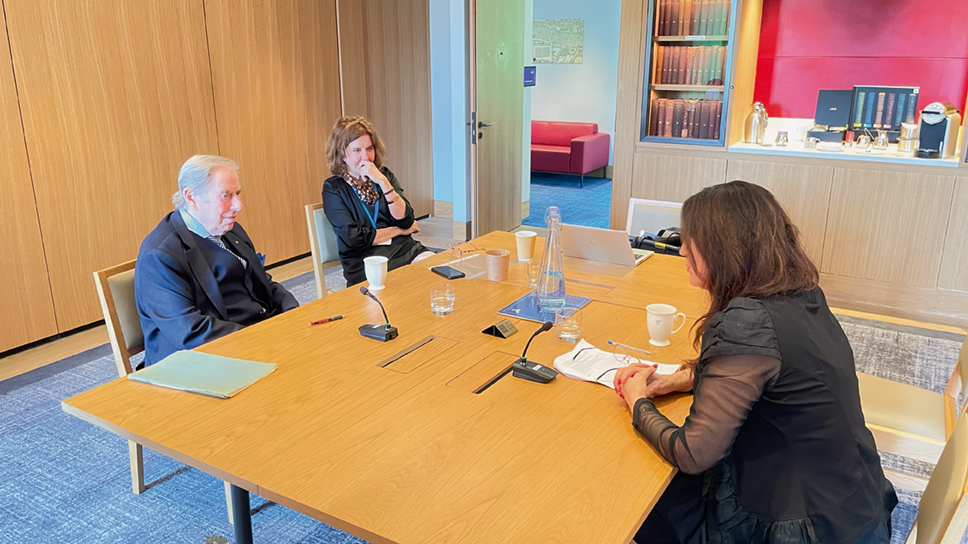 Master Lawrence
interviewed by Professor Edwards KC [Hon]
When you think you know a person, it is a special pleasure to interview Master Lawrence, Sir Ivan Lawrence, knighted in 1992, barrister and former Member of Parliament for Burton, reflecting on his distinguished career in law and politics.
I first met Master Lawrence MP over thirty-five years ago when domestic violence was a matter of public concern. Elected Chairman of the Home Affairs Committee on Domestic Violence in 1992–3, he said in Parliament: “Paragraph 136 of our conclusions defines that most basic of a citizen’s rights: the one of living a life where violence is not feared and individual dignity is respected”.
In his interview he recalls: “The importance of the select committee was, it was an institution whereby government was supervised by backbenchers sitting on these committees. And we had the right to call anybody to give evidence, including government ministers, to say, “What are you doing about domestic violence?”
Listening to Master Lawrence’s life narrative, his self-effacement, humility, humour, enthusiasm and passion for life, desire to do justice and meticulous attention to detail were traits formed early. These were apparent to Hugh Trevor-Roper and those who granted him, a grammar school boy, a scholarship at Christ Church, Cambridge. Self-deprecatingly, he considered he hadn’t done well at interview: “I’m not going to get this Common Entrance because they didn’t ask me any of the questions you would expect them to ask, like why did I want to read Law”.
He was awarded a place. At Oxford, his tutors were legal and philosophical luminaries. He then went to the Bar, breaking another ‘class ceiling’, and was called to the Bar (Inner Temple) in 1962. The influence of Lipman Oviotchki, Master Lawrence’s paternal grandfather, and his library of famous trials was seminal: “I was very attached to my paternal grandfather, and he had books in his library of the famous cases in Britain, and I used to read them avidly, and then I thought, that’s what I’d rather like to do. If I wanted to learn anything about anything, learnable, important, I would go up to London and read my grandpa’s books”.
His insatiable reading, preparation, and note-taking won him a tenancy at Queen Elizabeth Building: “I was a pupil at Queen Elizabeth Building, the famous venue of the outstanding criminal lawyers of the time: Jeremy Hutchinson, Victor Durand, Dick Du Cann, Dai Tudor-Price, Robin Simpson, John Streeter … the great people of the time in criminal practice”.
As pupil to James Burge, he was part of the defence team in the Stephen Ward trial: “I was blessed … to be James Burge’s pupil, and James Burge represented Stephen Ward, and so I was his junior when the trial of Stephen Ward took place in the early stages in the magistrates’ court at Marylebone”.
He was later junior counsel representing Ronnie Kray.
His pursuit of justice and experience as barrister and MP contributed to the Judges’ Rules and Police and Criminal Evidence Act 1984, introducing tape-recorded police interviews to combat ‘verballing’: “Look, why do you not allow tape-recorded interviews? Then there would be no dispute.’ Because it would be there on tape. One tape would be given to the prosecution, the other tape would be given to the defence, and they couldn’t be falsified”.
He describes the jury system as “the height of democracy” and fiercely defends justice and the importance of seeing law from all sides – prosecution, defence and judge.
His advice to students of the law is: “If you want justice in a society, you’ve got to have barristers who test the evidence, the defence counsel; barristers who produce the evidence in an understandable way [for] the jury; judges who are knowledgeable about the law”.
Professor Edwards: Master Lawrence, you have always acted justly and walked humbly. Thank you very much.