
Joshua Blew FSA – Butler, Librarian, and Collector
By Rob Hodgson, Librarian and Keeper of Manuscripts
Joshua Blew must have been one of the most extraordinary servants that any English institution ever had. – Conway Davies, 1972
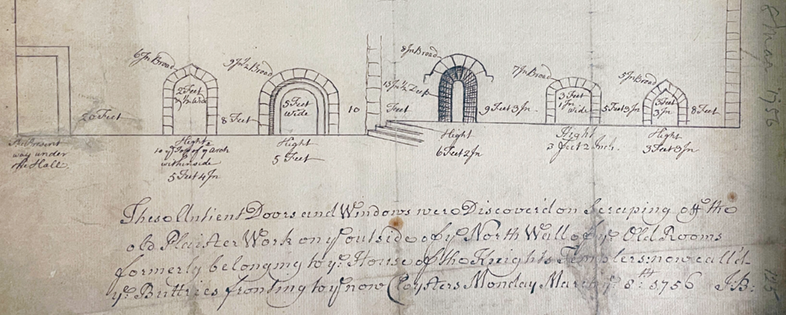
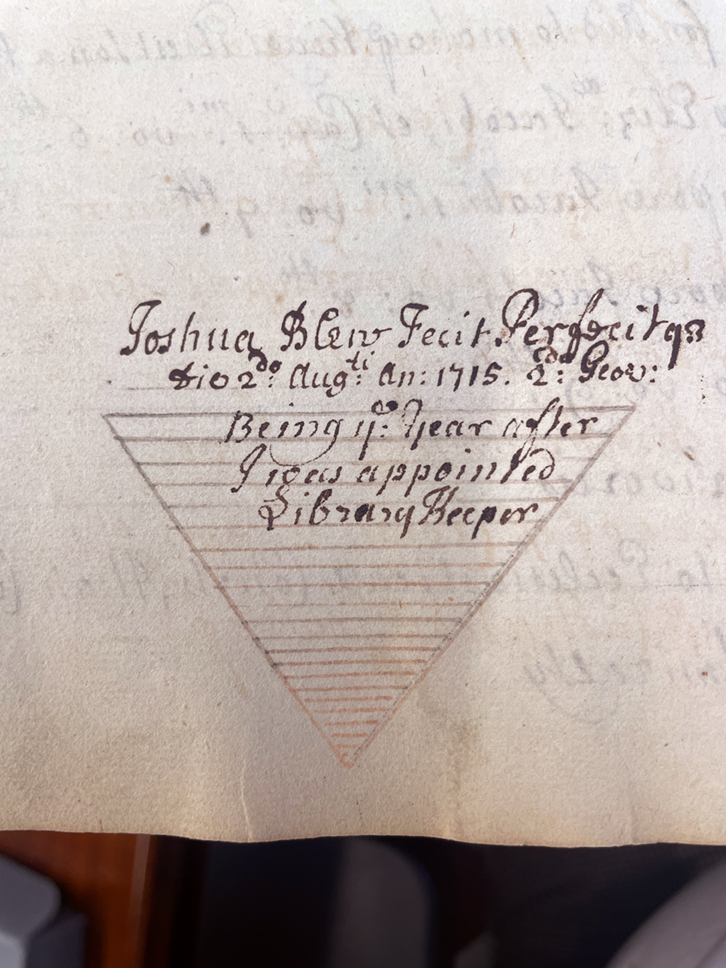
Blew’s duties and diligence in all things Inner Temple are well preserved and documented. His signature and initials appear on records of meat-weighing, statements on presidency, notes on soil, sketches of ancient windows, library catalogues and much more. Only one piece of personal correspondence has survived, as an adjunct to a business letter confirming the ‘dispatch of oysters’. It references the aftermath of a great fire that struck the Inn in January 1737. Many buildings, including Blew’s chambers were destroyed. In the note, sent 12 months later, Blew records excellent progress in rebuilding chambers and the kitchens, but on a personal level he confides that he is concerned that his wife, much affrighted by the fire, had to spend a long time under Dr Douglas’s care. In relation to his own wellbeing, he laments the loss of his “valuable collection of curiosities both of art and nature” which “daily distress of my mind with too many anxious thoughts”. This glimpse into his personal life struck a chord and made me look beyond Blew the Butler-librarian to focus on Blew the person (and, of course, his lost collections).
Life and Career
He first appears in the written record in 1687. The register of his birth in Bromyard, Herefordshire to butcher William Blew and his wife Grace. By 1709, aged c.21 (by his own reckoning), he was employed at the Inn although his lowly rank does not merit mention in the records until 1713 where he appears as fourth butler, commanded to ‘attend and keep the Library open at library hours till further order’. By July 1713 he has become Librarian and given the former Librarian’s chamber in Hare Court ‘to hold during pleasure’. i.e. for the duration of his employment. Six months later he is married to Mary Mounteney (b c.1698), and a son, Mark Anthony, is born in 1727. By 1728 Blew is promoted again and the family move into the chambers of his predecessor (Chief Butler John Crowder) at 8 Fig Tree Court. In a nice note of administrative and domestic interest, we also know that the Inn ordered ‘the carpet to be mended’.
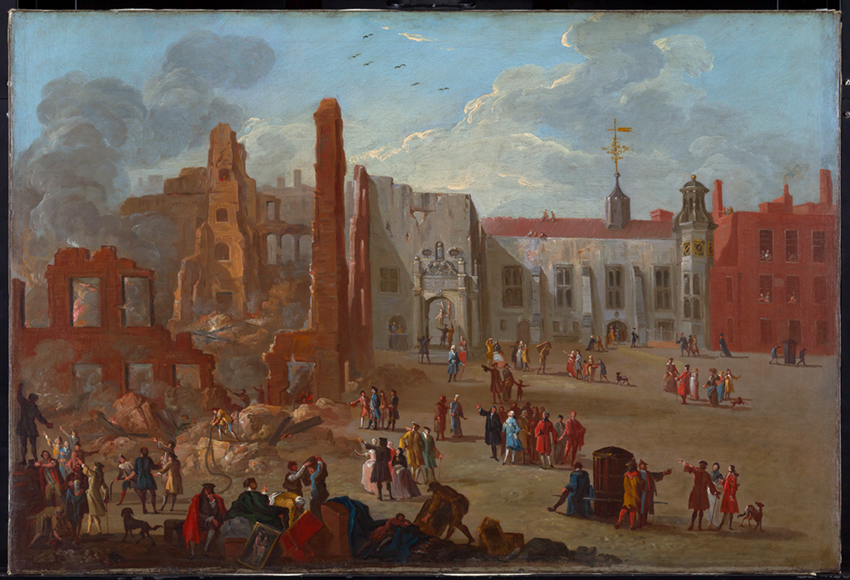
Blew is on the rise, but over the next 8 years we see tragedy and upheaval that must have impacted the couple terribly. By 1733 the deaths of Mark Anthony and a second son Broderick (a baby) are both recorded in the Records of Temple Church. In January 1737, a different and terrifying upheaval strikes Joshua and Mary Blew; the fire of Fig Tree Court. The fire burned from the early evening on Tuesday morning until 5am the following, when, according to Read’s Weekly Journal or British Gazetteer (Sat Jan 8 1737), its “fury was quite quenched by the engines and firemen”. 33 chambers are reported to be ‘entirely burnt down’ and ‘Mr Blew the Librarian’ is one of the 17 named in the article who have lost their chambers. The article continues that “Mr Peters the Deputy Treasurer’s chambers over the Kitchin are also burnt down; but his Chambers where he kept his Office and Papers are not much damaged, and he sav’d every Thing”. Mr Blew and his wife however were not so lucky. The London Evening Post (4–6 January 1737) reported that “Mr Blew, the Librarian, a very honest, worthy, communicative Man, who has been for several Years collecting Medals, Coins, Stones, etc. to the value of 5 of 600l (£) has lost them all in the Fire, besides his Goods”. That equates to well over £100,000 in the modern terms – a devastating loss. Within a month, Bench Table was discussing locating fire-cocks (hydrants) throughout the estate.
A small consolation, Bench Table Orders record: “Mr Blew to be excused the payment of rent from Michaelmas, 1736, to the 4th January following the chamber being burnt”.
Despite all these hardships Blew’s indefatigable work in support of the Inn continued. We can only speculate on the reality of his final years, but between March 1762 and January 1765 we learn of the death of his wife Mary (August 1762), witness of the sale of his collections, see his retirement from the Inn, and ultimately his death on 22 January 1765. He and Mary were both buried in the Round of Temple Church. Blew’s epitaph concluding “He lived / Beloved by all good Men / And died / Universally lamented.”

Blew the Collector
There are no extant lists of Blew’s collection before the fire but despite the losses he clearly continued collecting and was part of a ‘collector’s network’. What has survived are a posthumous sale catalogue, an auction catalogue, and occasional archival and print references to Mr Blew.
By 1741 he was elected a Fellow of the Society of Antiquaries. Between 1743 and 1751 their minute books recall that Blew exhibited: two Roman denarii, a silver piece [sic] of William and Mary “the whole beautifully struck and in fine preservation: supposed to have been a pattern for a farthing”, “six Silver Consular coins lately found in the Ruins at or near Genoa”, “a fine Silver Medal double gilt of Henry the IIIIth of France”, and “transcript of a marriage settlement in the time of Richard the First 1189–1199” (noted as ‘penes Jos Blew’).
As part of a network of antiquarians, circulating curiosities, his personal and professional interests overlap in and around the Inn. For example, in 1745 Blew’s annotations record that he has a copy of a manuscript ‘Concerning the Temples’ received via ‘Mr. John Nicholls, a curious antiquary, near the Bear Key, London, and by him lent to me, J. Blew’. This note and the manuscript copy remain in The Inner Temple Library collection. In the Herefordshire County Archive there is a bundle with a note: “All these old deeds were given me many years ago by Mr Joshua Blew … And: Coltee Ducarel.” Andrew Ducarel was resident in the Temple at the same time as Blew, on the panel that approved his fellowship of the Society of Antiquaries, and ultimately, executor of Blew’s will.
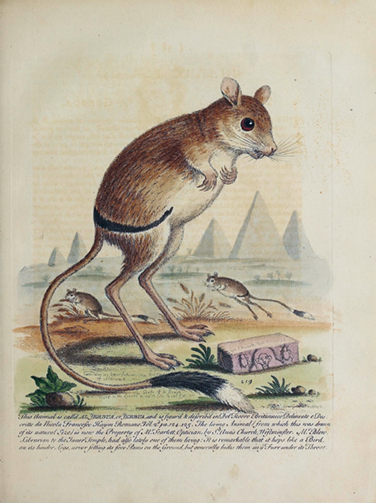
Beyond the silver, medals and documents, in 1751 Blew is acknowledged by George Edwards (the ‘father of British ornithology’) as a supplier of specimens from which the plates in various of his works are based. Blew provided a Bullfinches, a Black and Yellow Manakyn, and mammalian rather than avian, a Gerbua. The text accompanying plate 219 in Edward’s Gleanings of Natural features the Gerbua and a note that “Mr Blew Librarian to The Inner Temple had also lately one of them living”, adding elsewhere “the stuffed skin of which he lent me to examine”. The display of these curios including living specimens, must have been quite a spectacle within his chambers.
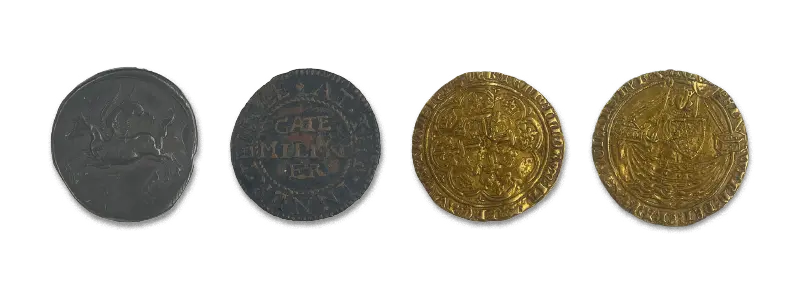
The year before Blew’s retirement, in March 1762, Mr Langford hosted the auction sale of ‘Genuine and Entire collection of Roman and English Coins and Medals… of Mr Joshua Blew’. The reason for the sale? Blew “has left off collecting”. In the main, the Antiquaries exhibits do not feature in the sale catalogue. Nevertheless, we can wonder if “the Silver Piece about the size of a new shilling with the heads of K William and Q Mary …beautifully struck and in fine preservation: supposed to have been a pattern for a Farthing” exhibited by Blew in April 1751 could have featured in Lot 27 of the Langford sale; ‘Proof Coins in Silver – five different farthings of William and Mary’. Amongst the coins, there are other fleeting glimpses into the variety of Blew’s collections; “part of a blade of an antique Roman sword”, “fossils and petrifactions”, trade tokens, and a ‘scarce’ noble from the time of Edward III.
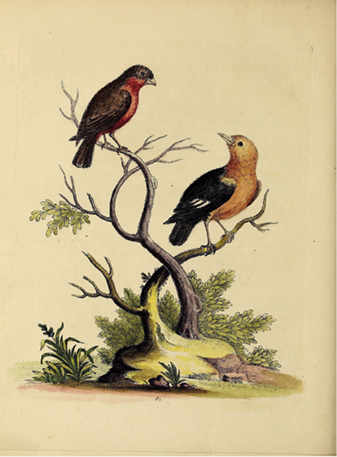
© Edwards, George, 1694–1773, Smithsonian Libraries and Archives, Biodiversity Heritage Library
We know from his will that his books, curiosities, and plate were to be sold with the profits “divided and paid to my nephews and niece”. Fortunately, the catalogue of that posthumous estate sale from March 1765 has survived. From this we can add colour to the emerging picture of the Blews and their rooms. Featuring day-to-day items of household paraphernalia most rooms seem functional, although the ‘four-post bedstead with crimson harrateen furniture’ and the wonderfully described ‘curious piece of work for a toilette, spangles etc.’ may be a little more expressive. Despite ‘leaving off collecting’, there are still curios in the sale catalogue. In the dining room we glimpse the likely remnants of collections; ‘six pictures of seaweeds framed and glazed’, ‘two pictures of Caesar and Domitian’, and ‘eighteen India pictures’ adorn the walls in room where the upholstery is of ‘green damask’. Other listed collectibles include, rare coins, ‘an Amythyst seal set in gold’, two swords, a roman lamp and finally, “twelve prints of birds etc. beautifully coloured by Edwards”. It would be satisfying to assume that these prints feature illustrations of specimens provided by Blew. Many of these items may have been new acquisitions – does any collector truly give up collecting? However, taken alongside clearly personal keepsakes such as ‘a child’s worked mantle and sleeves’, I prefer to believe that these remaining items and ‘curios’ are the things he simply couldn’t part with when selling his collections.
Despite ‘leaving off collecting’, there are still curios in the sale catalogue. In the dining room we glimpse the likely remnants of collections; ‘six pictures of seaweeds framed and glazed’, ‘two pictures of Caesar and Domitian’, and ‘eighteen India pictures’ adorn the walls in room where the upholstery is of ‘green damask’. Other listed collectibles include, rare coins, ‘an Amythyst seal set in gold’, two swords, a roman lamp and finally, “twelve prints of birds etc. beautifully coloured by Edwards”.
His Will
With frequent amendments (six codicils) his estate provides a glimpse into the family affairs and temperament of our aging butler. His nieces and nephews are bequeathed annuities from his South Sea Stock, but not without some pointed comments:
“to my other nephew Henry Blew … although he deserves no more of me than a crown piece to enable him to make up the odds of five pounds to a crown at the next cock match he shall happen to be at yet for the sake of his good wife and the poor children I give and devise to him the like sum of five hundred pounds … for the benefit of himself and family in hopes he will make a better use of it than what he did with what was left to him by his Uncle Harry.”
It is very tempting to draw our own conclusions of gambling and squander. Other cousins are similarly treated, original bequests precisely altered to leave the money in support of wives and families, pointedly keeping the funds out of the hands of the men who Joshua clearly is displeased with. He is similarly plain speaking about his original executor and ‘loving cousin’ Benjamin Fidoe (butler and brewer to the College of Westminster and Clerk of Works to the Abbey). Somewhere between November 1762 and November 1763 his feelings towards Fidoe change leading Blew to ‘utterly revoke and disannul’ all previously granted powers. The codicil records that “some time past for reasons utterly unknown to me [Fidoe] behaved himself with great coolness and indifference towards me in not so much as sending to enquire after me nor coming himself to see me”. Dr Andrew Ducarel, his friend and fellow antiquary is nominated executor to replace Fidoe, but “to show him [Fidoe] the love and esteem I still retain for him I leave him ten pounds only for mourning and a guinea ring as witness”. A considerable reduction from the 20 guineas promised to Fidoe prior to his ‘coolness’.
A potted history of his service to the Inn is impossible to fit into this space. For a detailed examination of Joshua Blew’s service to The Inner Temple readers are directed to the 2017–2018 Yearbook article ‘Joshua Blew: Chief Butler and Librarian 1713–1765’. Conway Davies breaks Blew’s duties into two categories – services to the Library, and general adviser and researcher to the Bench. After examining the remaining echoes of his personal life I am left wondering if the contacts made in his professional life enabled this butcher’s son and butler to operate in the same antiquarian circles as Ames, Ducarel, Norroy et al. He clearly faced hardship in his personal life, although financially he seemed very secure. The overall impression is of one who was efficient and business like. Who did not suffer fools and was frustrated (if not downright disappointed) by his wider family’s behaviour. This frustration, perhaps even more acute given that he had outlived his own immediate family, is balanced with a kindness – he was at pains to make sure the more vulnerable family members were looked after. Hunting for traces of Joshua Blew has been thoroughly rewarding, although I may not be done investigating quite yet. There were 74 lots of books entered into the estate sale – it seems unlikely that this librarian will be able to resist investigating Blew’s personal library…
Rob Hodgson
Librarian and Keeper of Manuscripts
SOURCES:
- This stone is now lost. According Arundell Esdaile author of Temple Church Monuments, 1933, ‘this was legible in 1893, near the grave of Oliver Goldsmith … the description is vague and rubbing several possible stones has given no results”
- Records of the Inner Temple, Vol. 31
- (Herefordshire County Archives – CF54/1)
- Society of Antiquaries (SAL/02/006/062)
- Based on James Conway Davies Catalogue of Manuscripts in the Library of the Honourable Society of The Inner Temple, OUP 1972.