
Geoffrey Nice Foundation
The Geoffrey Nice Foundation (GNF) on Law, History, Politics and Society in the Context of Mass Atrocities was established in 2014.
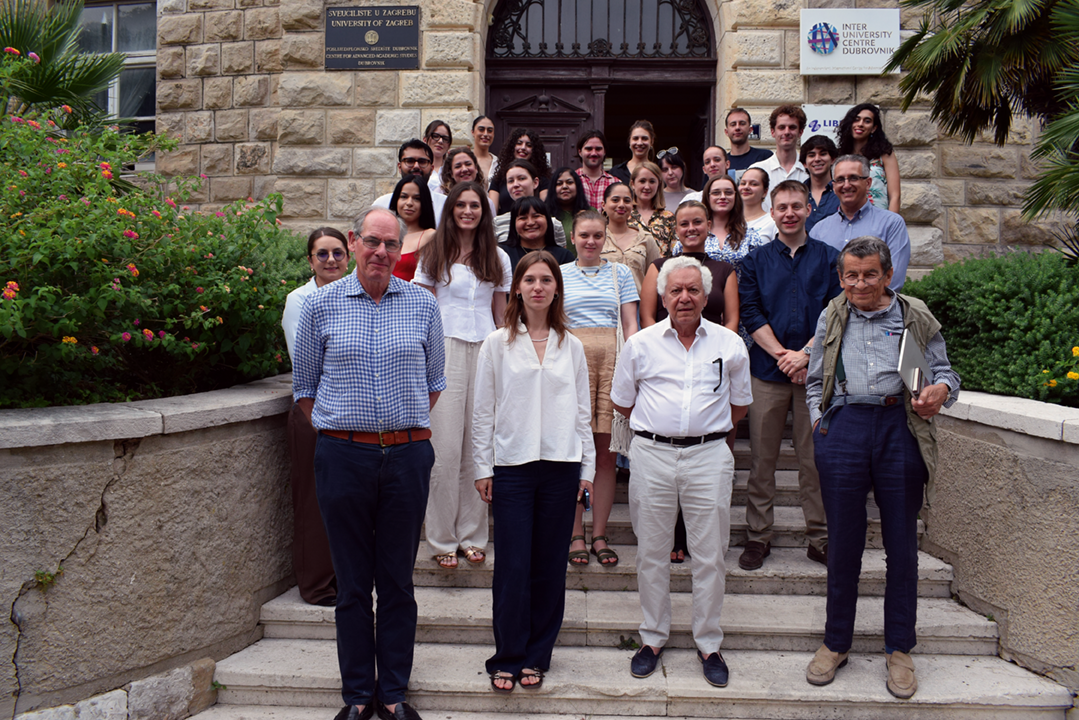
The aim of the GNF is to promote a better understanding of what can be done to avoid mass slaughter and of the role law and the individual can play. In order to achieve this, the GNF organises informal seminars each year lasting about a week covering legal, philosophical, political and religious issues. The seminars are attended in person by young people of widely different backgrounds from all over the world. A ‘faculty’ of speakers, some online others in person, with backgrounds in law, history, sociology, the armed forces and human rights also attend. During each seminar the participants talk with each other seeking to discover what in practice can be done now to minimise the chances of mass slaughter in the future. Parts of each seminar are made available online to the outside world.
The late 20th century wars in the former Yugoslavia ended in 1999. In 2014, they were nearer in memory than they are today. To begin with GNF Master Classes focused on accountability for war crimes committed in those wars. Every year since, some Master Class students came from the former Yugoslavia to hear and talk about what their parents, relations and even they had in common – armed conflict and its consequences.
There was no desire, then or since, from component parts of the former Yugoslavia – Slovenia, Croatia, Bosnia-Herzegovina, Serbia, Macedonia, Montenegro – to reconstruct the Federal Socialist Republic of Yugoslavia (FSRY). Rather did all former components – already or becoming independent republics – seek ways forward; if possible, within the EU, the Council of Europe and/or the UN. This reality was central to all accountability mechanisms: the UN’s International Criminal Tribunal for the Former Yugoslavia (ICTY), where many Inner Templers have served as interns, lawyers or judges, as well as at courts of once-component FSRY republics conducting war crimes trials.
The Inner Temple supported competitively selected young barrister students each year; first, four per year, more recently six. There were regularly students from the Netherlands and, with the passing of years, from all round the world. They created highly diverse multinational year-groups of students, many of whom have retained contacts with one another ever since.
There was and is much goodwill towards the former Yugoslavia and it was never difficult to find high level speakers to give their time pro bono to speak to GNF students. The Inner Temple contributed several speakers – practitioners and judges – as part of the faculty of speakers. They joined former presidents of parts of the former Yugoslavia, leading academics, judges of various courts and practitioners in law, a former European High Representative to the region, MPs from different countries, members of the UK House of Lords, a retired US War crimes ambassador, a sometime adviser to Putin, a leading UK businessman, international journalists, a former British General, Commander-in-Chief of UK’s Land Forces, the last surviving prosecutor at the post-World War II Nuremberg trials and many others.
At first the Master Classes lasted two weeks; more recently they are of six highly concentrated days – ‘immersion courses’, if you like – always in early July. All bar two at the Inter University Centre (IUC) in Dubrovnik, a centre created in the FRSY’s soft communist past to encourage freedom of discussion and exchange of ideas in many disciplines.
Each year the title and overall theme of the Master Classes has changed to reflect a changing – and increasingly dangerous – world. This year’s title reflected the fundamental issue worrying many, even those who enjoyed the uninvaded peace in the UK of the Cold War between 1945 and 1981 – ‘peace’, despite the UK being party to very many armed conflicts overseas:
HOW CAN WE HUMANS STOP [KILLING MILLIONS OF EACH OTHER IN] WARS?
Can we rely on International Humanitarian Law?
If not, on what else?
Politicians seem incapable of answering the question and it is easy to argue that war crimes trials and convictions do little or nothing to stop future wars – they do much else of value but not this.
To help with this very broad question we found ourselves hearing from and asking questions of lawyers and of those with knowledge and experience of the UN and other politics, of religion, pacifism, the arts and sport. Given the imperative for survival of the human race of stopping wars might all these and other disciplines help?
Over the years alumni have said attending GNF Master Classes has been life changing. Nothing so special about that. Any learning experience – a school lesson or university lecture, a film or a piece of music – can be a life changing event. But it has been reassuring to hear that those attending these modest events have found them valuable and for Inner Temple students there may be special value in being detached from the privilege of representing others, often over-focused on some narrow discipline, and in looking around and thinking freely.
Next year’s Master Class title has yet to be announced. But then the world has a few more turns to make before next July. Who knows where; Trump, Putin or even the Pope, the Archbishop of Canterbury or Iran’s Supreme Leader may by then have required us to move our thinking.
Master Geoffrey Nice
Master Ian Bonomy writes:
Two extraordinary events, the widespread and bloody wars in various parts of the then Yugoslavia in the early nineties, and the brief but exceptionally vicious genocide in Rwanda in 1994, raised in the international community grave doubts about the capacity of the constituent States of Yugoslavia and the new regime in Rwanda to re-establish order and properly functioning organs of government quickly enough to ensure that disorder did not spread to the surrounding regions. Both of these events were characterised by the commission of war crimes and crimes against humanity on a massive scale. It was fundamental to the restoration of peace and order that those most responsible for these crimes, both as leaders and perpetrators, should face justice.
What followed was the first really significant development in international criminal procedure since World War II and the ensuing trials at Nuremberg, Tokyo and other locations, namely the establishment by the United Nations Security Council of two ad hoc international criminal tribunals; the first in 1993 to try those responsible for serious violations of international humanitarian law in the former Yugoslavia since 1991 (the ICTY); and the second in November 1994 to try persons responsible for genocide and other serious violations of international humanitarian law in the territory of Rwanda, and Rwandan citizens responsible for genocide and other such violations committed in the territory of neighbouring States (ICTR).
In the campaigning to establish these novel institutions, the focus was not simply on the application of the criminal law as an instrument of justice replacing a failed justice system, and the obvious criminal justice benefits; punishment, deterrence and removal of any impunity gap. Emphasis was placed on a suite of additional benefits that were likely by-products of successful prosecution of senior figures in the conflicts. These included the establishment and thereafter the maintenance of peace, reconciliation within communities of those from different ethnic backgrounds caught up in conflict, the rendering of justice to 1,000s of victims and their families, and the compilation of an authoritative historical record of the conflicts.
As I recall events surrounding the establishment of the GNF, it was with a view to providing a means of increasing the chances that those potential benefits would be realised that Geoffrey devised the Master Class to provide a forum for education and debate about the need to find ways to avoid repetition of mass atrocities such as those in Rwanda and Yugoslavia in the broad context of law, history, politics and society. Over the years since, while the conflict in Yugoslavia has inevitably featured prominently in light of the involvement of Geoffrey and other presenters in the ICTY, many other comparable situations have featured. And, as I speak, the ongoing conflicts in Ukraine and the Middle East underline the continuing relevance of this Master Class to the ambition of all supporters of the GNF to bring an end to war and the inevitable related atrocities.
Master Konrad Schiemann writes:
I have never been able to attend the seminars in person and thus inevitably have missed taking part in most of the participants’ discussions as they tease out together what the underlying questions and tensions are.
In the course of preparing my contribution I was much stimulated by the following thoughts in the writings of Jonathan Sacks, an Honorary Bencher of The Inner Temple which I shared with the participants. In order to function effectively as a society, individuals come together as a group. This defines itself by including some and excluding others. So inevitably groups divide as they unite. Groups can live peacefully together but, in times of change and disruption when people are anxious and afraid they turn to what he calls pathological dualism which divides the world into two – our side, the children of light, and the other side, the children of darkness. Both religious and secular beliefs are prone to this. It can give rise to what he terms altruistic evil which recruits people to do evil things in the name of what is thought of as a compelling cause.
Other sources of stimulation for me as I got ready for the seminars were the philosophical attempts by Kant and others to identify universal truths of reason, philosophy and science. But Jonathan Sacks points out that these have not been universally accepted and have been succeeded by a belief in the unassailable and all-embracing sovereignty of the nation state, beliefs in the universal value of a political system or beliefs in the superiority of a particular race. These beliefs have led to wars, the Gulag and the KGB and mass racial murders.
Participants addressed questions such as what meanings have historically been given to the expression ‘human rights’; should they be regarded as rights of the individual or of a larger group; what are their sources?
This joint search for truth and reality seems to me to have been eminently worthwhile and we all emerged not just better informed but, I like to think, wiser.
A Student Perspective
Mohammed Subhan Hussain writes:
Sir Geoffrey Nice opened the week by stressing the value of cross-fertilisation between the ideas of the young and the old, and added, pointedly, that the old are not necessarily right. I arrived with a position: that ordinary people do not merely stop wars but start them, sustain them, and make them possible; that Nuremberg happened, the Rome Statute happened, and this century is still burying its dead in Ukraine, in Gaza, in Sudan, in Myanmar, regardless; and that peace and justice are outcomes, not mechanisms, and outcomes do not tell you what to build. Six exchanges revised that position in the following respects: (i) individual responsibility, from Lord Bonomy; (ii) the crime to which that responsibility attaches, from Horst Junk; (iii) responsibility at the level of the state rather than the individual, from General Sir Nick Parker; (iv) the provenance of rights themselves, from Sir Konrad Schiemann; (v) the cost of adjudication to those who carry it out, from Her Excellency Judge Kimberly Prost; and (vi) the cost of documentation to those who carry it out, from Alex Crawford.
I came to Dubrovnik with a position built from doctrine: peace, justice, the architecture of international courts, and an abiding scepticism that any of it deters much. I left with something narrower. Violence is constrained only where three conditions hold together: (i) enforceable responsibility, whether individual or state; (ii) protected documentation; and (iii) dissent that fits the culture in which it arises. It recurs wherever any one is missing. The result is closer to an infrastructure than a doctrine, and not something a textbook could have given me.
I came to Dubrovnik with a position built from doctrine: peace, justice, the architecture of international courts, and an abiding scepticism that any of it deters much.
Sir Geoffrey’s opening remark cuts both ways. The old are not necessarily right, but on this showing, neither are the young: every exchange that changed my thinking ran in the same direction, from the more experienced to the less, and I do not take that to be coincidental; it is what the week was designed to produce. Its most consequential effect was on the postgraduate research I am now developing for doctoral study.
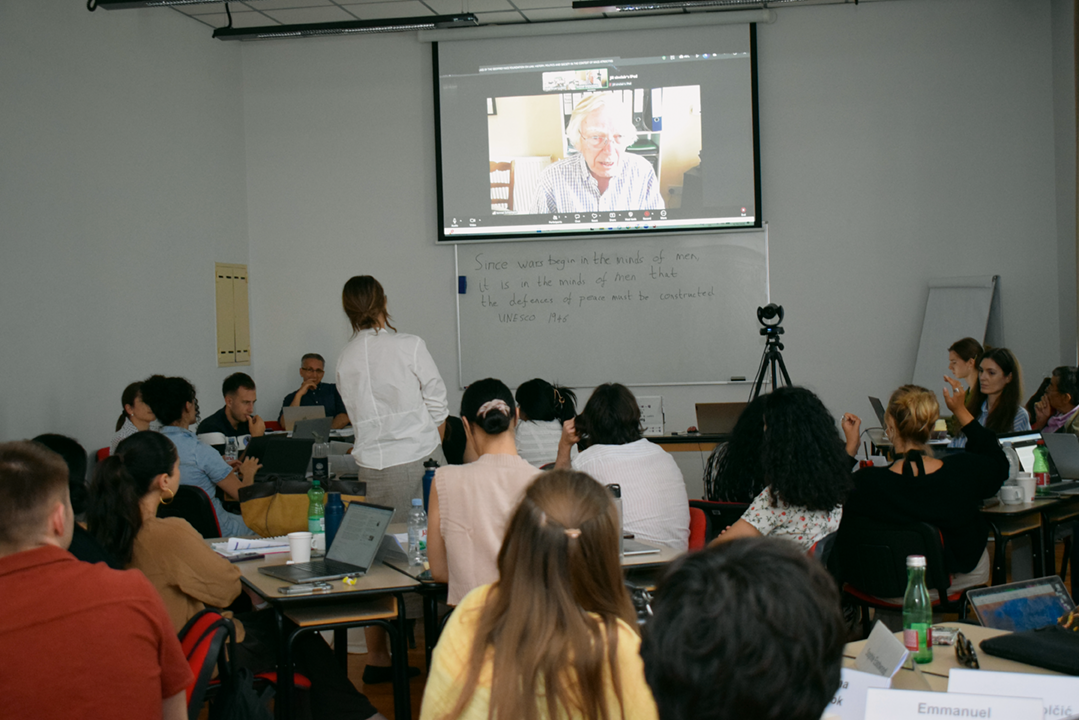
The doctoral thesis I am now proposing asks whether international law can hold a state responsible for force it deliberately finances but does not command. What Dubrovnik gave that question was not an answer but a second vantage point: General Sir Nick Parker had identified precisely the same blind spot from an operational perspective that no research proposal could have supplied. I return from the Master Class with fewer assumptions, sharper questions, and a firmer resolve to see that thesis through.
Of the twenty or more faculty speakers, six in particular had already lived the accountability problem my doctoral thesis takes as its narrower case: Bonomy’s responsibility, Junk’s crime, Parker’s state, Schiemann’s rights, and Prost and Crawford’s cost, each with a face attached to it before it had a footnote. That is not a bad place for a thesis to start.