
‘Eating Dinners’
In the 1860s Charles Dickens published an unflattering article about becoming a barrister. It was later published in a volume of articles called Uncommercial Traveller where he described the process of dining as “having a frayed old gown put on in a pantry by an old woman, and so decorated, bolted a bad dinner in a party of 4…”
‘Eating Dinners’, ‘Dining Nights’ and ‘Keeping terms’, even today, immediately identifies the rite of passage of a student into the profession of barrister. How it has changed from the earliest times when textbooks and law schools did not exist and young entrants to the profession learned the law and the professional norms and ethics from more senior members of the Inn – the Readers and practitioners – over dinner in Hall. My own baptism in the later 1960s, a hundred years after Charles Dickens published his view, required me to eat 36 dinners over three years without once being exposed to any law! We sat in Messes of four students, ate food of a very different quality to the Bar and Bench tables. The bonus was that each Mess was provided with a half bottle of sherry, a litre of wine and a half bottle of Lord Goddard’s Port. It was said that Lord Goddard had been to Portugal on holiday, had tasted excellent vintage port and had taken it upon himself to buy several pipes for the Benchers of Inner. Alas, what arrived in due course did not appear to be of the remembered standard that the Lord Chief Justice had tasted. Caveat Emptor! It was, however, deemed suitable for students and we rejoiced in its high alcohol content and repented the next day.
‘Dinners’, no longer qualifying sessions, are now rather different – enjoyable opportunities for learning and for meeting senior members of the Inn. They serve their original, educational purpose in a more contemporary and effective way, giving students opportunities to learn ‘soft’ skills, to interact and learn from more senior members.
Currently, dinners in Hall tend to be for more formal occasions, which are held less often and the food provided by our caterers is of a much higher standard. For obvious reasons, they do not want the responsibility of using, or losing, the silver cutlery accumulated by the Inn over the centuries. The Executive and Bench Table have approved the sale of this now unused tableware, and we have decided to offer it first to members and staff of the Inn. Most of it is engraved with our emblem – the Pegasus – and we hope many will wish to purchase some item or items to remind them of their connection to this Inn.
Aside from knives, forks and spoons of differing patterns, there are pieces that reflect past eating habits; beautiful silver meat skewers, lump sugar tongs, bone marrow scoops, salt and mustard spoons, fish knives and forks and asparagus tongs.
Samples of what is for sale are contained in a display case on the fourth floor of the Treasury Building. Do go and look. If you are tempted, please check with the staff in the Treasury Office, or email silversale@innertemple.org.uk for a catalogue. The money raised will be used to add to our collection of Silver.
This year our silver articles are of a more domestic nature and Richard Parsons, our expert silver adviser has written about the need for Porters and Watchmen at times when the area was less salubrious. Three of our Porters’ badges are on display in Hall. They are beautiful items and have an interesting history.
His Honour Michael Lawson KC
Master of the Silver
INNER TEMPLE PORTERS’ & WATCHMANS’ BADGES, HEAD PORTER’S STAFF
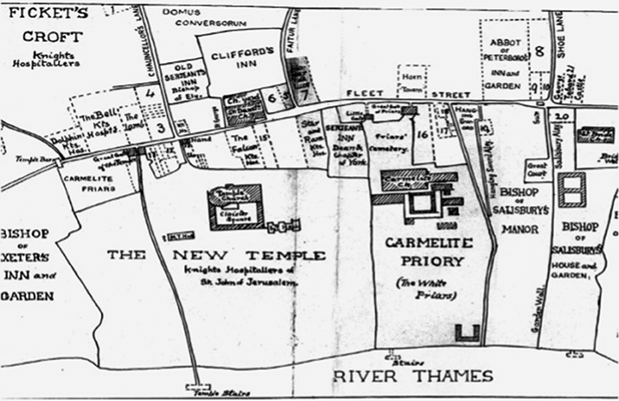
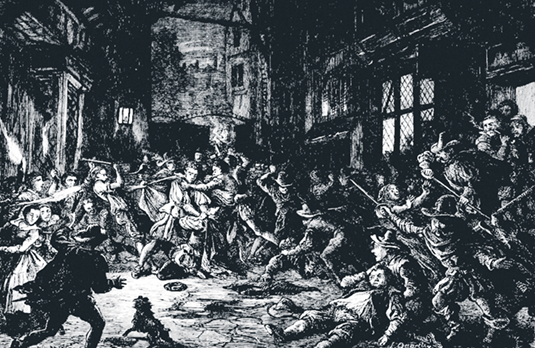
From early times and certainly over the last three hundred years it has been a City of London practice for the display of authority to be distinguished by a mace, staff, badge and or clothing. This article considers the need for security and order in The Inner Temple estate and the display of authority through the wearing of silver badges and a staff. For the Inn these silver badges, often worn on a cloak, sleeve or chest were made of different sizes depending on the rank of the wearer, whether a porter or watchman.
The location of The Inner Temple was next to the Carmelite monastery known as Whitefriars, a place of sanctuary for all manner of criminals seeking protection, which created an unpleasant community. Though the monastery was torn down with the dissolution, the ground still provided sanctuary, and it turned into a chaotic refuge for debtors, criminals and a disreputable theatre called the Alsatia. A famous clash occurred on 1 July 1691 after the Benchers of The Inner Temple became sick of the Alsatians creeping into their land. On bricking up a common passageway between the two sites a massive, pitched battle took place and it took a major military intervention to restore order. It is thus possible to understand why the Inn needed its own almost police force to keep the peace and security particularly after another two crimes of murder. In 1727, Mr Darby, a clerk in the chambers of Sir George Cooke, was found murdered, which prompted an immediate review of security. He had been shot in the head, with wounds to his ear and hand, while his rings, watch and other valuables had been stolen. The other is a grizzly triple murder in 1733 of an elderly woman and her two female servants in Tanfield Court.
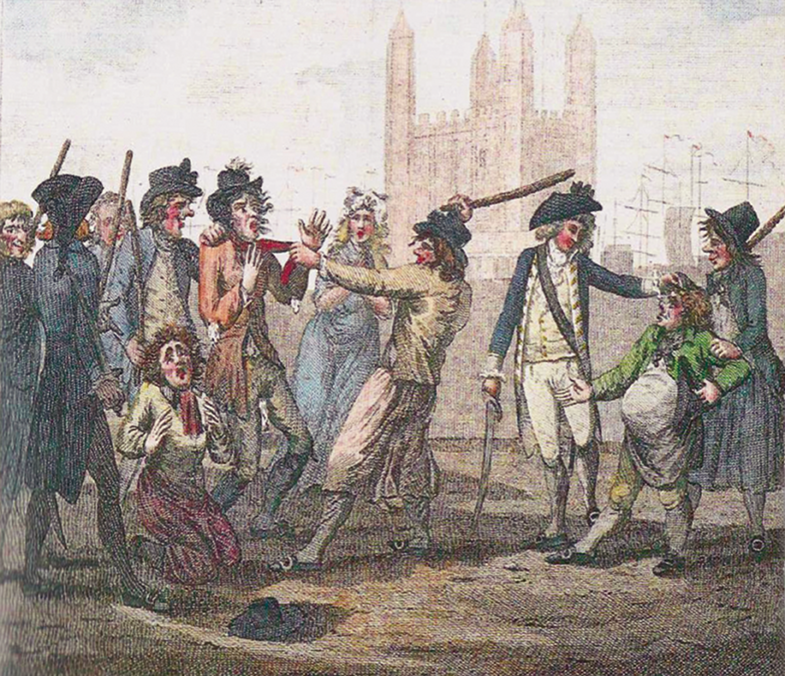
Another problem for the porters and watchmen were the press gangs that roamed the City during the 18th and early 19th centuries forcing men into naval service. The wearing of a recognised badge or token helped men avoid being captured and pressed. For residents of the Inn to see a watchman wearing a badge must have provided a feeling of security, particularly at night.
Currently security of the estate is maintained by the Inn’s porters who are identified by a small silver Pegasus found on their jacket lapel. Six such badges are recorded in the Temple silver inventory. One of this group is hallmarked for London 1882, the others for London 1949 and apart from the 1882 example they are numbered from 1 to 5. Unfortunately, any further silver hallmarks they bear are rubbed making them undecipherable.
In the Parliament records of 28November 1574 there is an early record for the need of porters and their badges.
“Whereas, as well on the feast day of the Purification of our Lady as on the feast day of Allows, store of pewter of long time hath been used to be lost within this House partly for want of diligent porters of the said feastdays 8s for the payment of sufficient persons to act as porters”.
An early mention of silver badges is in the General Account book of Richard Fifield, Chief Butler from 4 November 1660 to 3 November 1661 nearly 100 years later, where there is a record for a silver ‘barge’ for the basket porter which cost 5 li, a considerable sum of money compared with the organist receiving 12.1/2 li for half a year.
Further at the Bench Table held on the 1,9,11 and 12 February 1688–9, it is recorded that “Buckle the badge porter and William Berry who is nominated the head porter to deliver him the badge and chain, and that a committee consider the duties of the porter”. This entry illustrates that another metal badge existed at the time, probably of silver, and was worn from a chain around the neck as a chest plate. Neither of these badges exist in The Inner Temple’s silver collection.
The earliest mention of the staff is in the Bench Table Minutes of May 1684 “that the porter’s staff be delivered to the deputy porter and that the deputy porter pro hoc vice (for this occasion) have a gown and staf.” In the same year, “To the goldsmith that made the porter’s staff and for a bamboo, the silver head 16 oz. 8 dwt. The fashion, the ferrule, fastening and engraving 4li”. All did not go well for the deputy porter for in May 1693 “Upon witnesses being heard touching the robbery of John Legh is ordered that John Browne, the under-porter, be immediately put out of his place, and that William Berry, the head porter do bring the said Browne’s staff to the treasurer”. Further between 17 November 1692 and 19 November 1693 the staff suffered “To the goldsmith for altering the porter’s staff and ‘horse’ 4li 14s”.
However, the head of the staff is engraved for the year 1705 and the Treasurer’s name of Thomas Walker for that year. It is also engraved for the assay results as “This head more by ye Essay 4dts” being a fineness of 0.20 oz troy. Then again between 18 November 1704 to 18 November 1705 in the Treasurership of Thomas Walker “to the silversmith for the flying horse on the porter’s staff [for the horse in new starling wayes’, 31 oz. 14 dwt. at 5s. 5d. per oz., the fashion of it at 1s. 9d. per oz. for engraving two inscriptions and the assay], 11li .8s. 2d”.
The detail ‘in new starling wayes’ could be translated as new sterling wares as previously lower grade silver had been used to make the cane top prior to 1685, as shown by the assay and the piece bears no hallmarks because it would fail to meet the sterling standard even with the additions.
The following are a group of eight badges recorded in the Bench Table Orders for the Trinity Term of 6 July 1728 for the watchmen after the murder of Mr Darby.
“Upon the petition of Rice Jones, Robert Huxley, Samuel Jones, Henry Lloyd, Thos. Jones, Wm. Norris, James Browne and Jno. Sharp, watchmen to this Society, silver badges to be given to them with the arms of the Society engraved thereon, not exceeding ten shillings each in value, and recommended to the Under Treasurer to take care there of”.
The cost of these badges does not appear as a separate item in the accounts.
On 27 November 1728 the following badges were authorised for the porters.
The Treasurer “to order 6 badges for the porters, of silver plate, not exceeding thirty shilling for each badge, to be worn as long as they continue porters and to be returned on demand to the Treasurer of the Society for the time being”.
The eventual purchase of these badges is found in the accounts for 19 November 1728, to 21 November 1729.
“Mr. Jonathan Barber for 6 badges with the arms of this Society thereon, at £1 10s. each, to be worn by the porters £9-0-0”.
Neither Heal nor Grimwade (directories of London gold and silversmiths’ marks and lives) help in identifying who Jonathan Barber might be, but it is interesting that a Huguenot silversmith named John Barbut (beard in old French) could be anglicized into the name Barber. He registered his first mark on 22 July 1726 which would fit with the first mention of Jonathan Barber in The Inner Temple Calendar of that year, perhaps a recently indentured apprentice might cost a little less than a master. Grimwade mentions some confusion of the names at this time as the immigrant French Huguenot silversmiths became accepted in the English trade, which they revolutionised after a time and often changed their French names to be accepted.
In passing, on 10 June 1735 “The head and second cooks, and Mr. Farlow, the head porter, were fined 6s. 8d. apiece, and Cox, the steward’s man, 3s. 4d., for their indecent and disorderly behavior behind the screen”. From many other entries it would seem that Mr Farlow was highly regarded, but clearly life was not dull.
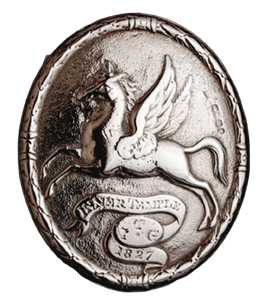
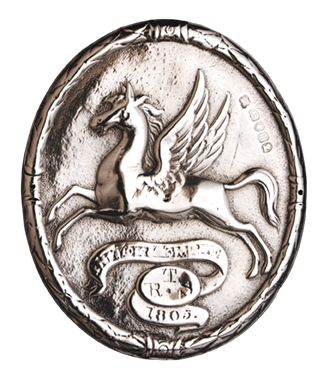
The Inn’s collection contains 12 ancient silver porter’s badges which were replacements for the earlier badges mentioned above, where no distinction in size was made between a porter or watchman, except for the Head Porter’s badge which was much larger. They are cast, of a good weight, with rings on the back for garment attachment or neck chains. Often old silver was sent to the silversmith to be reworked saving on the replacement cost, and one can imagine that it happened here with the old, possibly worn, badges being re-worked.
Of the surviving badges, seven are marked with the London date letter of 1804/5, (numbered one to six). A larger one is (unnumbered) with the maker’s mark of Thomas Phipps & Edward Robinson II. In the accounts for 1804–5 a Mr. Whipham, silversmith, was paid £38.12 as the supplier of the seven badges although they bear the maker’s mark of Phipps & Robinson.
Heal records Thomas Whipham senior being removed from Ave-Mary Lane to the Grasshoper (No 61), near White Friars, on the South Side of Fleet Street so he would have been quite local to The Inner Temple. Grimwade mentions Whipham was apprenticed to Thomas Farren for £21 and was free on 3rd July 1725; he died in 1765. His son Thomas continued the business as Whipham and North at the same address and was Prime Warden of the Goldsmiths’ Company in 1790 and died in 1815. It could possibly be that because Heal records that he, Thomas Whipham Jr, worked from 1790 to 1802 still at the same address, he subcontracted the work out to Phipps and Robinson hence the badges bear their mark. Although not himself working he was still retained by The Inner Temple.
Three are for London 1827/28 and the maker’s mark is of Charles Rawlings. His first mark was entered in the London Assay Office on 3 July 1817.
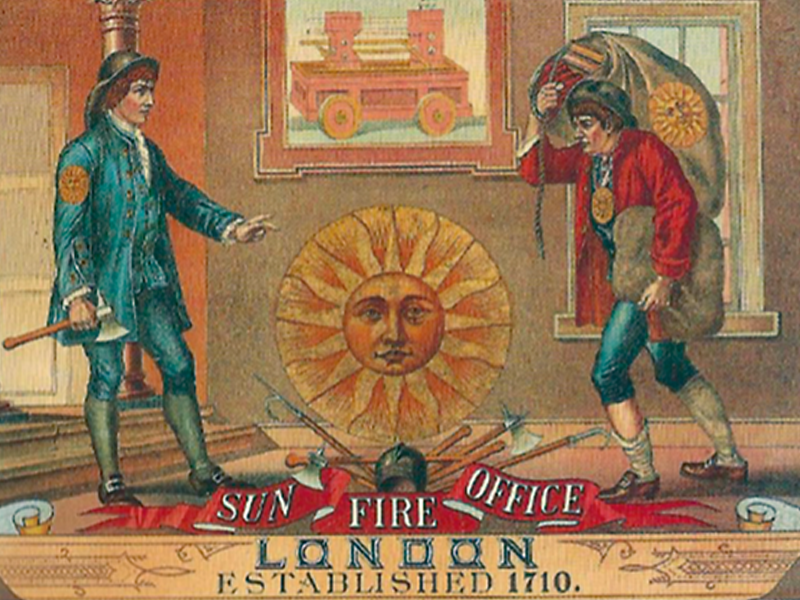 One is for London 1854 (numbered 8). The maker’s mark is for Charles Thomas Fox who worked for a number of retailers including Lambert and Rawlings. He also made the 16 silver Pegasus salts seen on the table at dinners.
To view examples of the silver, the large badge for 1804/05 can be seen in the Hall display cabinets with two of the greater number of smaller badges placed either side and within the gold Abinger collar.
Richard Parsons
Jeweller and Silversmith
To explore the Inn’s collection of silver:
nrtm.pl/silver
With thanks to The Inner Temple Archivist, Celia Pilkington, for access to information. Alsatia: The Inner Temple’s Lawless Neighbour by Dr. C M Rider, Archivist. Many Volumes of the Calendar of The Inner Temple Records. London Goldsmiths 1697 to 1837 by Arthur Grimwade. The Directory of Gold & Silversmiths Jewellers and Allied Trades 1837 to 1914 by John Culme. The London Goldsmiths 1200 to 1800 by Sir Ambrose Heal FSA. Badges of Extinction: The 18th and 19th Century Badges of Insurance Office Firemen by Brian Henham & Brian Sharp.